

Frequently Asked Questions
Sectional Title – some brief explanations
Living in a Sectional Title scheme means community living. This is particularly true for people who have chosen to live in a townhouse. Flat owners can, if they wish, choose a fairly isolated lifestyle. Apart from contacts in lifts, passages, communal gardens and basement parking areas, flat dwellers are often isolated from their neighbours. Townhouse owners on the other hand, because of a more open lifestyle usually have more contact with their neighbours. Where a large number of people live in close proximity to each other, problems sometimes arise. Most of these problems can be avoided if all the owners in a scheme show consideration for each other and do not behave in a thoughtless or selfish manner. Among these problems are excessive noise from radios, televisions and CD players. Less common, but by no means unknown, is the noise from parties, washing machines and spin dryers, opening and closing doors, moving furniture, the use of musical instruments etc. While none of these types of noises are unacceptable during the day, they constitute a nuisance late at night or early in the morning. A washing machine in use on a ceramic tiled kitchen floor in an upstairs flat late at night can keep many people awake!
Let us look at some of the questions most frequently asked by sectional title owners.
WHAT IS SECTIONAL TITLE?
A Sectional Title Development Scheme (usually referred to as a “SCHEME”), provides for separate ownership of a property, by individuals.
WHAT DO I OWN?
In buying into a scheme, you will acquire a section (or sections), and an undivided share of the common property collectively known as a Unit. In practical terms, a section is usually a flat or townhouse. A section extends to the median (center) line of its walls, floors and ceilings.
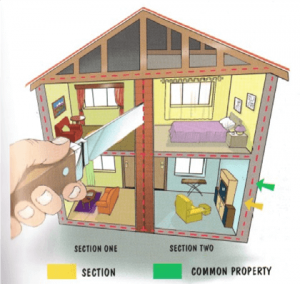
WHAT IS COMMON PROPERTY?
The Common Property is that part of a sectional title scheme which does not form part of any section. Driveways, gardens, swimming pools, corridors and entrance gates are good examples of common property.
WHAT IS AN EXCLUSIVE USE AREA?
Often this will be a garden or patio attached to a section, in which case you do not OWN the garden or patio, but you have EXCLUSIVE USE of those areas for as long as you are an owner in the Scheme.
WHO CONTROLS THE COMMON PROPERTY?
The common property is controlled by the Body Corporate. There are no exceptions to this rule. The practical implications of this are that even though parts of the common property are designated as exclusive use areas, they arein many respects are controlled by the Body Corporate and are therefore subject to the rules of the Scheme.
WHAT IS THE BODY CORPORATE?
The Body Corporate is the collective name given to all the owners of Units in a Scheme. It comes into existence as soon as the developer of the Scheme transfers a Unit to a new owner. All registered owners of Units in a Scheme are members of the Body Corporate. The Body Corporate controls and runs the Scheme. Day-to-day administration of the Scheme is vested in TRUSTEES who are appointed by the Body Corporate. Major decisions regarding the Scheme are made by the Body Corporate, usually at the ANNUAL GENERAL MEETING (AGM), or at a SPECIAL GENERAL MEETING. At these meetings, matters which affect the Scheme are discussed, Budgets are approved, Rules can be changed and Trustees are appointed – often accompanied by lively discussions! Each member of a Body Corporate is entitled to vote at these meetings, providing that the member is not in arrears with levy payments or in serious breach of the Rules.
WHO ARE THE TRUSTEES?
The Trustees are usually owners in a Scheme who have been entrusted with the task of looking after the Scheme on a day-to-day basis. Trustees are appointed by the Body Corporate. The minimum number of Trustees for a scheme is two. The Act does not specify the maximum number. Ideally, a trustee should possess skills or qualities which will be of benefit to the Scheme.
WHO MAKES THE RULES?
At the inception of a Scheme, MANAGEMENT and CONDUCT RULES are established. As their names imply, the management rules control the running or management of the Scheme, while the conduct rules lay down guidelines for the conduct of owners and their guests or tenants.
MAY THE RULES BE CHANGED?
Yes. The Body Corporate can change the Rules, providing that these changes are not against the spirit of applicable legislation. The procedure which must be followed before rules can be changed is clearly defined in the Act.
WHAT IS A LEVY?
The costs incurred in running a scheme have to be paid by the body corporate. These costs include:
- Water and electricity used on the Common Property
- Insurance premiums for the Common Property and Units
- Repairs and maintenance of the Common Property
- Wages and salaries of the cleaners and other staff
- Security
These costs are paid for by individual owners in the form of a monthly levy, calculated in accordance with the participation quota for their unit.
HOW IS THE LEVY CALCULATED?
At the inception of a Scheme and again before every AGM, the trustees have to prepare a budget for the following year. This budget is then presented to all members of the body corporate at the AGM. The body corporate can either accept the budget or can ask for changes to be made.
Once the budget has been accepted, the total annual cost is divided into a monthly amount. Each owner is then “levied” a monthly amount, which is his or her share of the common budget. The amount is calculated in accordance with the Participation Quota (PQ) of the owner unit. Larger Units have a higher PQ than smaller units and the amount paid by each owner will vary accordingly.
MAY THE LEVY BE CHANGED AT OTHER TIMES?
Yes. In an emergency, the Trustees can impose a SPECIAL LEVY to cover expenses of an unforeseen nature. In addition to this, the Body Corporate can approve a special levy to cover the cost of improvements to the common property.
WHAT ARE MANAGING AGENTS?
Managing and administering a Scheme, particularly a large Scheme, is complicated and time-consuming. Occasionally, the Body Corporate and Trustees undertake the entire task. Unless the Body Corporate is unusually well endowed with specialised knowledge and talents, this is seldom successful. Most Bodies Corporate decides to appoint MANAGING AGENTS, usually a company or close corporation that specialises in this aspect of Sectional Title administration. The Managing Agents collect the monthly levies and all other amounts of money due by owners to the Body Corporate. They keep the books, recover unpaid debts, prepare the annual budgets, arrange for quotations for repairs and maintenance, send out notices and generally assist the Trustees with the numerous time-consuming tasks that arise in administering a Scheme.
MAY I KEEP A PET?
It is not surprising that permission to keep a pet is covered by the very first rule (Rule 1) of the conduct rules, as much unhappiness and heartache have been caused by a failure to understand this rule. An occupant of a Sectional Title unit may not keep a pet in a Scheme without the written consent of the trustees, which consent the trustees may not refuse without good reason. In considering an application, the trustees have to be guided by the type of pet and the nature of the scheme. In granting consent trustees may impose special conditions and may withdraw the consent if the pet causes a nuisance to other owners. Passions run high when it comes to pets! Please note that often a Body Corporate will, by Special Resolution, amend conduct rules to ban all or certain types of pets.
MAY I MAKE ALTERATIONS INSIDE MY SECTION?
Generally, it is not necessary to obtain permission to make alterations inside a section. However, if these alterations involve structural changes or affect the electrical or water supply, or the drainage system, it is essential to obtain expert advice, especially if the changes require major structural changes, such as the removal of a wall. As a matter of courtesy, you should advise your neighbours if the alterations are going to cause them any inconvenience or excessive noise. Builders can cause a lot of noise and dust! Many owners renovate their kitchens and bathrooms, add extra cupboards, re-tile, or re-carpet floors without causing any problems. Please remember that all changes that affect the common property require consent.
MAY I EXTEND MY SECTION?
An owner wishing to extend his or her section must first obtain permission from the Body Corporate, by means of a special resolution. The owner will be responsible for all the costs of amending the sectional plan, re-calculating all the participation quotas and having the amended plan approved and registered. The owner will require the services of an architect or land surveyor and an attorney.
MAY I INSTALL A SECURITY GATE OUTSIDE MY FRONT DOOR?
Yes. However, as the security gate will be visible from parts of the common property, in the interests of conformity the trustees will have to approve the pattern and colour of the gate.
MAY I FIT AN AWNING OUTSIDE A WINDOW?
As the outer walls form part of the common property, Body Corporate consent will be required. It is common practice to fit awnings to north and west windows and it would be very unreasonable to refuse permission. However, the rules prevent an owner from doing anything which upsets the harmonious appearance of the Scheme, so the colour and style of the awning will have to conform to an approved pattern.
MAY I FIT A DIFFERENT TYPE OF FRONT DOOR?
The front door is visible from common property and in the interests of uniformity, the door must conform to an approved design.
MAY I CHANGE THE STYLE OF THE WINDOWS?
Windows are generally considered to be part of the common property. Therefore, permission would be required, and would probably not be granted.
MAY I BUILD A WALL AROUND MY EXCLUSIVE USE GARDEN?
The exclusive use garden forms part of the common property. Therefore, consent is necessary.
MAY I EXTEND MY PATIO?
A patio is usually part of the common property so consent would be required.
MAY I FIT A GATE FOR MY CARPORT?
A car port is part of the common property, and consent is therefore is required.
MAY I INSTALL A SPA BATH INSIDE MY SECTION?
Apart from structural problems caused by the weight of the installation and the water in it, the installation of a spa bath (Jacuzzi) requires alterations to the plumbing and electrical wiring so permission is needed. A spa bath may require more electrical power than is available in your section, in which case it might be necessary to provide a three-phase supply to the section. This is a major task and would undoubtedly require expert advice.
MAY I FIT AN AIR-CONDITIONER?
Air-conditioning units that take air from outside the building are partly installed outside the section, therefore permission is necessary. Another consideration is the noise generated by the compressor in the air-conditioner.
MAY I INSTALL MY OWN SATELLITE DISH?
No. A satellite receiving dish must be mounted outside on the common property which will require consent from the Body Corporate. Apart from this, an owner cannot do anything that will affect the harmonious appearance of the section. Individual dishes, visible from outside the building would without doubt be very inharmonious and therefore cannot be allowed.
IS THE TRUSTEES AS POWERFUL AS THEY SEEM TO BE?
No, not at all. The trustees are appointed by the Body Corporate to look after the interests of the Scheme and comply with instruction of the members of the Body Corporate. A Body Corporate is not subject to the Companies Act; hence the trustees are not seen as Directors of the Body Corporate. The role of a trustee is a responsible one, and very time-consuming and considered by many to be a thankless task. Good trustees are a valuable asset in any scheme and deserve support from members of the Body Corporate.
WHAT SHOULD I DO IF MY NEIGHBOURS BREAK THE RULES?
If your neighbours consistently break the rules by making too much noise or being a nuisance in some other way, you should report them to the South African Police Service and a trustee. Please remember however that you should involve the trustees only in the case a of serious disagreement and not in trivial disputes or law enforcement.
WHAT HAPPENS IF I FAIL TO PAY MY LEVY?
The Body Corporate can take action in an appropriate Court to recover unpaid levies. In extreme cases, the Court may order the sale of the owner’s movable assets, or even the sectional unit itself. As all owners in a scheme have to pay a levy, any owner who fails to pay his or her levy, while continuing to enjoy the benefits of living in the Scheme, is doing so at the expense of all the other owners. An owner who is in arrears with his or her levy may not vote at a general meeting of the body corporate, except for proposed special or unanimous resolutions.
The Body Corporate is entitled to charge interest on arrears. All costs involved in recovering money owed by an owner to the body corporate can be claimed from the owner who is in arrears.
WHAT ABOUT INSURANCE?
The Sectional Title Act requires the body corporate to ensure that the buildings are insured to the value of the replacement cost in the event that the complex is totally destroyed. The insurance must cover all the sections and all the improvements to the common property. The insurance premium form part of the monthly levy.
Please note that the body corporate insurance only covers the damage and destruction of the buildings. It does not cover the contents of your unit. You must make sure that your furniture and personal belongings are separately and adequately insured through a suitable policy.
MY QUESTION IS NOT LISTED HERE. HOW DO I GET IN CONTACT WITH YOU?
Please direct any enquiries to communication@vpmteam.co.za and we will provide you with the information required.